Coffee Calculators
Pour Over Coffee Calculator: Dose, Water and Timing
The pour over coffee calculator sets your dose from a 1:16 ratio, then this page covers grind, bloom, pour stages and total brew time.
Sections6
Pour over gives you more control than any other manual method, which also means more ways to miss. The pour over coffee calculator above fixes the first variable for you by setting the dose from your water volume at a 1:16 ratio. Enter the water you plan to use and it returns the coffee weight, the bloom pour and the target brew time.
What follows is the technique the numbers assume. Ratio decides strength, but grind size and pour rhythm decide whether the cup is balanced or hollow.
Short answer: use 1 gram of coffee for every 16 grams of water. A single mug means about 22 g of coffee to 350 g of water. Grind medium, use water at 195 to 205 F, bloom with 44 g for 30 to 45 seconds, then pour in stages and finish draining by about three minutes.
What the pour over coffee calculator sets for you
The default is 1:16, the middle of the 1:15 to 1:17 filter range. Pour over and drip share that range because both work the same way: water passes through a bed of coffee once and drains away.
The tool also gives you a bloom weight, which is simply twice the coffee dose. A 22 g dose blooms with about 44 g of water. That is enough to wet every ground without any liquid running through into the cup.
The rest of the water goes in after the bloom. Whether you pour it in two stages or four is personal, but total water and total time should stay the same brew to brew. That consistency is what lets you judge a change.
Common dose and water pairs
All of these use 1:16 and finish as filter strength coffee, not concentrate:
- 250 g water: about 16 g of coffee, one small cup
- 350 g water: about 22 g of coffee, one large mug
- 500 g water: about 31 g of coffee, two mugs
- 700 g water: about 44 g of coffee, a six cup Chemex
- 1,000 g water: about 62 g of coffee, a full batch brew
Water weight and volume are interchangeable here, since 1 ml of water weighs 1 g. For a stronger cup move to 1:15, so 350 g of water takes 23 g. For a lighter cup at 1:17 it drops to 21 g. The gap sounds trivial and tastes obvious.
Grind, temperature and the pour itself
Grind medium, about the texture of table salt, for a cone dripper. Chemex filters are thicker and drain slower, so a slightly coarser grind keeps the brew from stalling.
Water belongs at 195 to 205 F (90 to 96 C). Off the boil and rested for half a minute lands there without a thermometer. Cooler water gives a sour, hollow cup, and boiling water pushes toward bitter.
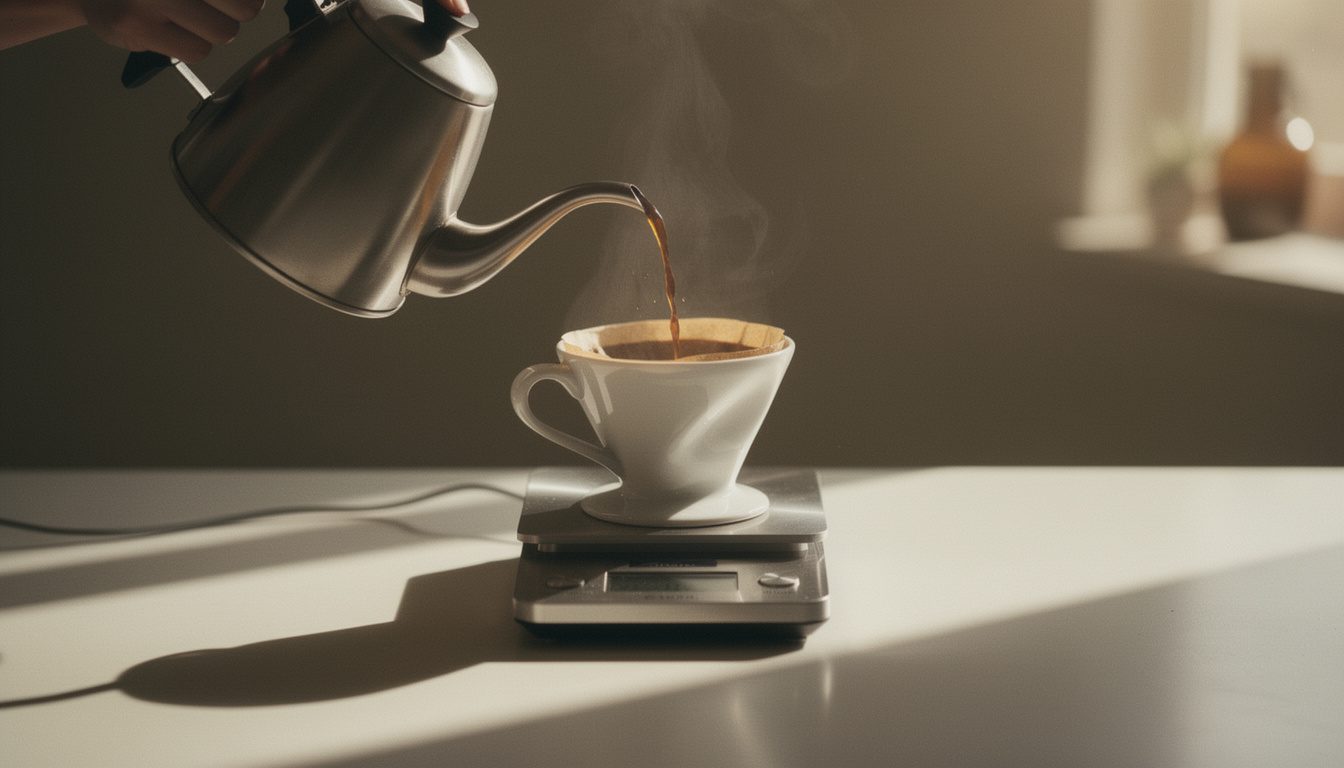
Pour in slow circles from the center outward, then stop short of the filter edge. Water that runs down the paper skips the coffee entirely. Let the bed drop most of the way between pours instead of flooding it, and finish with a level bed rather than grounds stranded up the sides.
Reading the drawdown clock
Time is the honest feedback for grind size. A single cone brew should be done draining between two and a half and three and a half minutes. A Chemex batch runs four to five.
Too fast and the coffee tastes thin and sour, so grind finer. Too slow, with water pooling on top, and it turns bitter and dry, so grind coarser. Adjust the grinder one step at a time and rebrew before judging.
As an Amazon Associate, this website earns from qualifying purchases.
A steady stream is most of the battle, which is why a gooseneck pour over kettle changes more cups than any other upgrade at this stage. The BrewChart Card puts the pour over ratio, grind, bloom and timing on one printable page alongside every other method.
Fixing an uneven brew
Channeling is the usual culprit when a cup tastes both weak and harsh. It means water found a fast path through the bed and left the rest of the coffee behind. A level bed, a gentle bloom and pours that stay off the filter edge all reduce it.
Stirring or swirling gently right after the bloom evens the bed out. So does a small swirl at the end of the last pour. Both are common practice among people who brew the same recipe daily.
If the cup is consistently sour rather than uneven, that is straight under-extraction and the fixes are finer, hotter or longer. The full breakdown is in why coffee tastes sour.
The verdict on the pour over coffee calculator
Lock the ratio, then spend your attention on grind and drawdown time. The pour over coffee calculator above removes the arithmetic so the only judgements left are taste and the clock. Start at 1:16, brew the same recipe three days running, and change one thing at a time after that.
If you brew more than one way, the coffee to water ratio calculator carries every method's range. How much coffee per cup turns the same math into scoops for machine brewing.
Quick answers
How much coffee for a single pour over?
About 22 g of coffee for 350 g of water, which is the 1:16 ratio and fills a large mug. For a smaller cup, 250 g of water takes about 16 g. For two mugs, 500 g of water takes about 31 g of coffee.
What is the bloom and why does it matter?
The bloom is a first small pour, about twice the weight of your coffee, left to sit for 30 to 45 seconds. It lets trapped carbon dioxide escape from fresh grounds. Skip it and gas pushes water away from the coffee, which gives an uneven, sour cup.
How long should a pour over take?
A single cone brew should finish draining between two and a half and three and a half minutes. A larger Chemex batch runs four to five minutes. If it drains much faster the grind is too coarse. If it stalls and puddles, the grind is too fine.
Do I need a gooseneck kettle for pour over?
Not to begin with, but it changes the result more than most gear. A gooseneck spout gives a slow, controlled stream you can aim in circles. A normal kettle dumps water in bursts, which digs channels in the coffee bed and extracts unevenly.
What grind size works for pour over?
Medium, roughly the texture of table salt, for a V60 or similar cone. Go a little coarser for a Chemex, since its thicker filter slows drainage on its own. Adjust by drawdown time rather than by eye, because grinders vary in how they label settings.
Why does my pour over taste sour?
Sour usually means under-extraction, so the water did not pull enough out of the grounds. Grind finer, use hotter water in the 195 to 205 F band, or slow your pours so the total brew runs longer. Change one of the three at a time.