Coffee Calculators
Coffee to Water Ratio Calculator (Grams, Cups, Scoops)
Use the coffee to water ratio calculator to get exact grams of coffee and water for any brew method, starting from a 1:16 default.
Sections6
Coffee gets easier the moment you stop guessing. The coffee to water ratio calculator above turns one number, the water you plan to brew, into the exact weight of ground coffee you need. It runs on the golden ratio of 1:16 by default, which means 1 gram of coffee for every 16 grams of water. Move the ratio and every result on screen moves with it.
The numbers on this page are the same ones the tool uses. They come from published industry practice, the ranges most roasters and brewing guides print on the bag. Learn them once and you can dose a pot by eye when you have to.
Short answer: use 1 gram of coffee for every 16 grams of water, which is about 60 g of coffee per liter. That is roughly 2 level tablespoons per 5 oz cup. Go to 1:15 for a stronger cup and 1:17 for a lighter one. Weigh the coffee, weigh the water, and keep everything else the same.
What the coffee to water ratio calculator gives you
Enter your water in grams or milliliters. For brewing purposes 1 ml of water weighs 1 g, so the two are the same number. The tool divides that by your chosen ratio and shows the coffee dose. Ask for 1,000 ml at 1:16 and you get 62.5 g of coffee, which most people round to 60 g per liter.
You can also work backward. If you have 20 g of coffee left in the bag, multiply by 16 and you get 320 g of water. That is a little over two 5 oz cups. Working backward is how you make the end of a bag land somewhere you actually like.
One warning about the word cup. A coffee maker "cup" is 5 fl oz (148 ml), not 8. A kitchen measuring cup is 8 fl oz. The carafe markings on a drip machine use the 5 oz version, which is why a 12-cup pot holds about 1,775 ml rather than 2,840 ml.
The golden ratio in plain numbers
The accepted range for drip and pour over runs from 1:15 to 1:17. The middle of that range, 1:16, is the safest place to start. In per-liter terms it is about 60 g of coffee per liter of water.
Here is what 1:16 looks like at common batch sizes, using 5 oz coffee maker cups:
- 1 cup (about 148 ml): 9 g, just under 2 level tablespoons
- 4 cups (about 590 ml): 37 g, about 7 level tablespoons
- 8 cups (about 1,180 ml): 74 g, about 15 level tablespoons
- 10 cups (about 1,480 ml): 92 g, about 18 level tablespoons
- 12 cups (about 1,775 ml): 110 g, about 22 level tablespoons, or 11 scoops
The 12-cup line is the one worth memorising, because it is the size most home machines brew. At the stronger end of 1:15 it becomes about 118 g. At the lighter end of 1:17 it drops to about 104 g. That whole spread is only 14 g of coffee, and you can still taste the difference.
Brew method presets in the coffee to water ratio calculator
Different brewers pull flavor out at different speeds, so the ratio shifts with the method. These are the ranges the presets use:
- Drip and pour over: 1:15 to 1:17, medium grind
- French press: 1:12 to 1:15, with 1:14 as the default, coarse grind, about 4 minutes
- Cold brew concentrate: 1:4 to 1:5, then diluted about 1:1 in the glass
- Cold brew, ready to drink: about 1:8, coarse grind, 12 to 18 hours
- Espresso: about 1:2, dose in to drink out, in roughly 25 to 30 seconds
Water temperature stays the same across the hot methods: 195 to 205 F (90 to 96 C). Water off a rolling boil, left alone for half a minute, lands in that band. The french press calculator applies the 1:14 default for you if that is your brewer.
How to measure when you have no scale
Volume is less accurate than weight, but it works if you keep it honest. One level tablespoon of ground coffee is about 5 g. A standard coffee scoop is 2 tablespoons, so about 10 g. Level the spoon off with a finger instead of heaping it, because a heaped tablespoon can hold half again as much.
Grind size changes the weight of a spoonful. Fine grounds pack tighter, so the same spoon holds more coffee. Roast level matters too, since dark roast beans are less dense than light ones. That is the whole case for weighing: grams do not care about grind or roast.
As an Amazon Associate, this website earns from qualifying purchases.
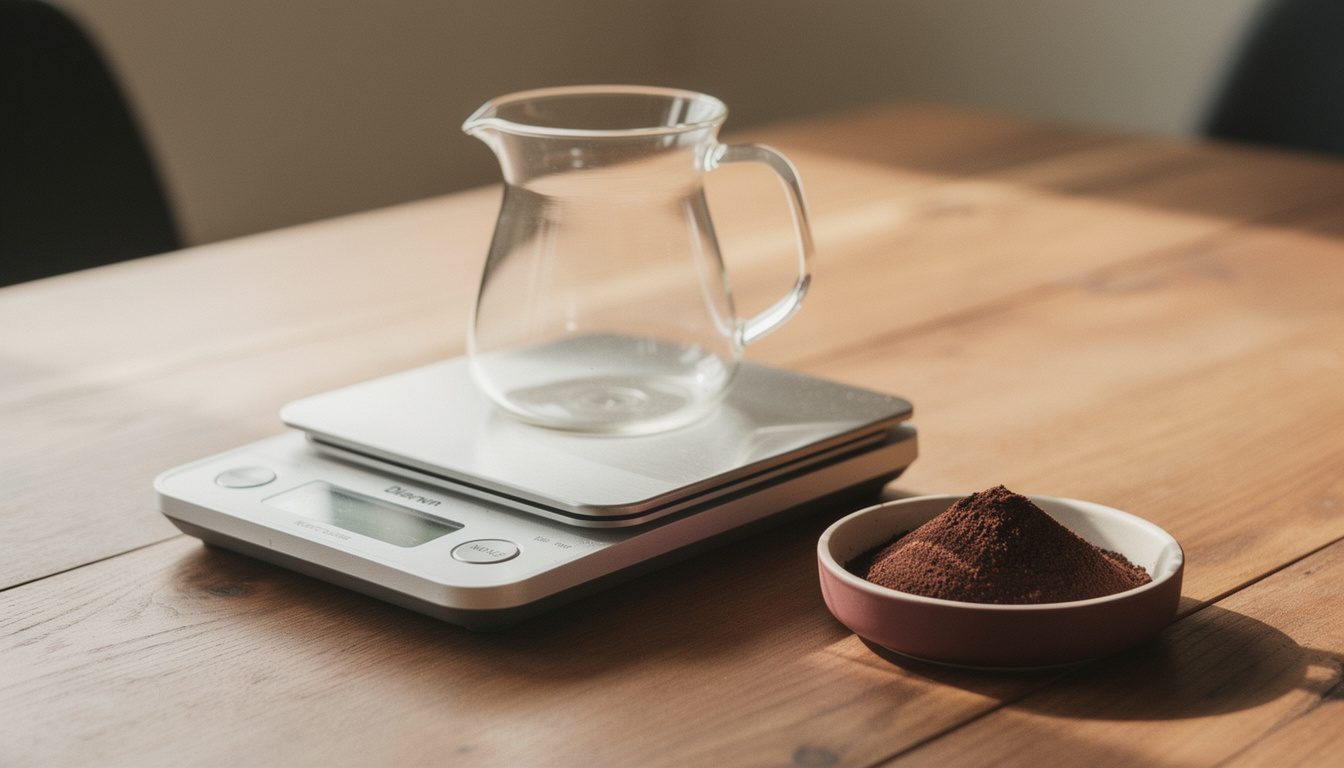
If you brew every day, a small digital coffee scale takes the guesswork out for about the price of two bags of beans. The BrewChart Card puts every ratio, dose and grind setting on one printable page, along with a bitter versus sour fix tree for the mornings a brew goes wrong.
What to change when the coffee tastes wrong
Ratio is one of four levers. The others are grind size, water temperature and contact time. Change one at a time or you will never learn which one fixed it.
Bitter, harsh or burnt coffee usually means over-extraction. Coarsen the grind, cool the water slightly, or cut the contact time. Thin and sour coffee usually means under-extraction, so go finer, hotter or longer. The causes are broken down further in why coffee turns bitter.
Strength and extraction are not the same thing. More coffee at the same grind makes a stronger drink, not a better extracted one. If your cup tastes weak and sour at once, adding coffee will not save it. Grind finer first, then revisit the ratio.
The verdict on the coffee to water ratio calculator
Start at 1:16, weigh both sides, and move one variable at a time. That is the entire method, and it beats every scoop-counting habit it replaces. The coffee to water ratio calculator above handles the arithmetic so your attention goes to taste instead of math.
Once your ratio is settled, the per-cup doses are worth knowing by heart. How much coffee per cup breaks the same math into scoops and tablespoons for the batch sizes people actually brew.
Quick answers
What is the best coffee to water ratio?
For drip and pour over, 1:16 by weight is the balanced default, which is about 60 g of coffee per liter of water. The full accepted range is 1:15 to 1:17. Go to 1:15 for a stronger cup and 1:17 for a lighter one, then adjust from there.
How many grams of coffee per cup of water?
A coffee maker cup is 5 fl oz, or about 148 ml. At the 1:16 ratio that works out to roughly 9 g of ground coffee, which is just under 2 level tablespoons. An 8 oz measuring cup of water needs about 15 g, or 3 level tablespoons.
Does the coffee to water ratio calculator work in ounces?
Yes. Ratios are weight to weight, so any unit works as long as both sides use it. One gram of water equals one milliliter, which keeps the math simple. If you prefer ounces, remember that a coffee maker cup is 5 fl oz while a kitchen measuring cup is 8 fl oz.
Should I change the ratio or the grind first?
Change the grind first. Ratio controls how strong the drink tastes, while grind size controls how much flavor the water pulls out of the grounds. A cup that is weak and sour needs a finer grind, not more coffee. Adjust one variable at a time so you know what worked.
How much coffee do I need per liter of water?
About 60 g per liter at the 1:16 ratio. The exact figure is 62.5 g, and most people round it down. For a stronger liter use 67 g, which is 1:15. For a lighter liter use 59 g, which is 1:17. Coarse brewers like a french press want more.
Do I really need a scale for this?
Not to start, but it helps more than any other purchase. Ground coffee changes weight per spoonful with grind size and roast level, so tablespoons drift. Weight does not drift. A scale is the difference between a recipe you can repeat and a cup that is different every morning.