Coffee Calculators
How Much Coffee Per Cup? Scoops, Tablespoons, Grams
How much coffee per cup: about 9 g for a 5 oz coffee maker cup, 15 g for an 8 oz mug, with scoop counts.
Sections6
The honest answer to how much coffee per cup depends entirely on which cup you mean. A coffee maker "cup" is 5 fl oz, or about 148 ml. A kitchen measuring cup is 8 fl oz. The mug on your desk is probably 10 or 12. Those three numbers need three different doses, and mixing them up is the single most common reason a pot comes out wrong.
The calculator above handles the conversion for you. Pick your cup size and count, and it returns grams, tablespoons and scoops at the balanced 1:16 ratio.
Short answer: use about 9 g of ground coffee per 5 oz coffee maker cup, which is just under 2 level tablespoons or one standard scoop. For an 8 oz mug, use about 15 g, or 3 level tablespoons. That comes from the 1:16 golden ratio, roughly 60 g of coffee per liter of water.
How much coffee per cup, by cup size
Start with the three sizes people actually use. All figures use 1:16 by weight.
- 5 fl oz coffee maker cup (148 ml): about 9 g, just under 2 level tablespoons
- 8 fl oz measuring cup or small mug (237 ml): about 15 g, about 3 level tablespoons
- 12 fl oz large mug or travel cup (355 ml): about 22 g, about 4 level tablespoons
The 5 oz figure is the one your machine assumes. Carafe markings, scoop instructions in the manual and the "cups" on the water window all use it. That is why a pot that says 10 cups only fills about six normal mugs.
Two level tablespoons per cup is the old rule of thumb, and it holds up. It runs slightly strong against 1:16, closer to 1:15, which suits most people brewing at home.
Scoops and tablespoons, and where they go wrong
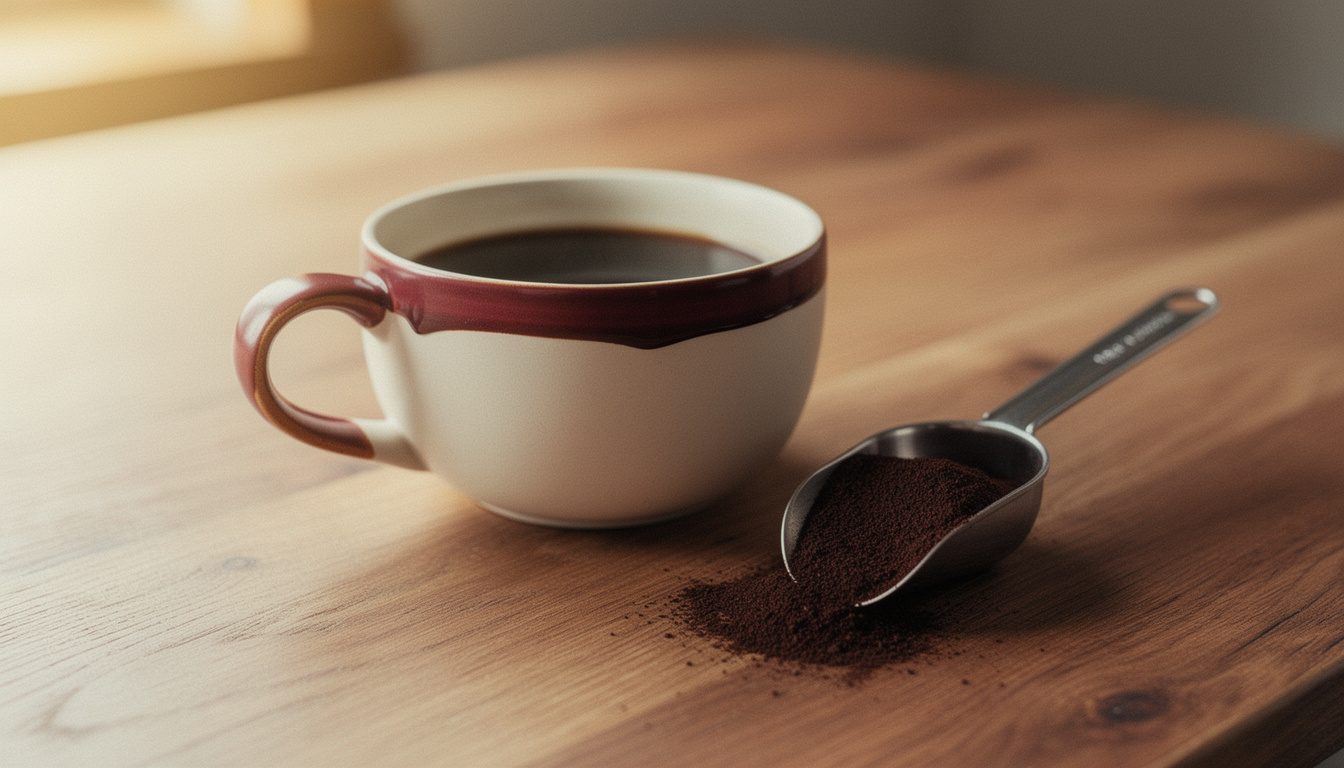
A standard coffee scoop is 2 tablespoons, which is about 10 g of ground coffee. That makes one scoop per coffee maker cup a clean rule you can use with no equipment.
Level tablespoons matter more than the count. A heaped tablespoon can hold half again as much as a level one, so a pot dosed with heaped spoons drifts well past strong and into bitter. Drag a finger or a knife across the spoon each time.
Not every scoop that comes in a bag of beans is a real 2 tablespoon scoop. Some hold a single tablespoon, some hold three. Weigh yours once on any kitchen scale, note the number, and use it forever after.
Batch sizes: 4, 6, 8 and 10 cups
These are the doses for a drip machine at 1:16, using 5 oz cups:
- 4 cups (about 590 ml): 37 g, about 7 level tablespoons or 4 scoops
- 6 cups (about 890 ml): 55 g, about 11 level tablespoons or 5 to 6 scoops
- 8 cups (about 1,180 ml): 74 g, about 15 level tablespoons or 7 to 8 scoops
- 10 cups (about 1,480 ml): 92 g, about 18 level tablespoons or 9 scoops
Small batches are the hard ones. Most drip machines are built around a full basket, and a four cup brew often passes through too fast and lands sour. If you regularly brew that little, a pour over cone will treat you better than the machine will.
Anything larger than 10 cups follows the same math without surprises. Full pot numbers are covered in how much coffee for 12 cups, which is the size most home machines are sold at.
Adjusting the dose to taste
Ratio is a starting point, not a verdict. Once your cup is consistent, move it in small steps. Going from 1:16 to 1:15 adds about 6 percent more coffee, and to 1:17 takes about 6 percent away.
On an 8 cup pot that is the difference between 69 g, 74 g and 79 g. Brew one setting for a few days before deciding, because your palate resets fast and a single side by side test proves less than you think.
As an Amazon Associate, this website earns from qualifying purchases.
Weighing beats measuring for exactly one reason: grams do not change with grind size or roast. A small digital coffee scale turns a rough rule into a repeatable recipe. The BrewChart Card keeps every one of these doses, plus grind sizes and a bitter versus sour fix tree, on a single printable page.
When the dose is right and the coffee still tastes off
More coffee makes a drink stronger. It does not make it better extracted, and those are separate problems. A cup that tastes thin and sour is under-extracted, and adding scoops just gives you more sour coffee.
Fix extraction with grind, temperature and time. Finer grind, water at 195 to 205 F (90 to 96 C), and a longer contact time all pull more flavor out. The reasoning behind each of those is in why coffee tastes sour.
Stale beans are the other quiet culprit. Coffee more than a month past roast tastes flat at any dose, and no scoop count brings it back.
The verdict on how much coffee per cup
Use about 9 g per 5 oz coffee maker cup, or 2 level tablespoons if you have no scale. Scale up from there in a straight line and the numbers never surprise you. That is the whole answer to how much coffee per cup, and the calculator above just saves you the multiplication.
If you brew by pour over rather than by machine, the pour over calculator gives you dose, bloom weight and timing in one place.
Quick answers
How many tablespoons of coffee per cup?
About 2 level tablespoons for a 5 fl oz coffee maker cup, which comes to roughly 9 g of ground coffee. For an 8 fl oz mug, use 3 level tablespoons, or about 15 g. Level the spoon rather than heaping it, since a heaped spoon holds far more.
How many scoops of coffee per cup?
One standard coffee scoop per 5 oz cup. A standard scoop holds 2 tablespoons, which is about 10 g of ground coffee. That makes scoop counting easy: 8 cups needs 7 to 8 scoops, and 10 cups needs about 9 scoops at the balanced ratio.
How much coffee for 8 cups?
About 74 g of ground coffee for 8 coffee maker cups, which is roughly 1,180 ml of water. That works out to about 15 level tablespoons, or 7 to 8 standard scoops. For a stronger pot use 79 g, and for a lighter one use 69 g.
How much coffee for 4 cups?
About 37 g of ground coffee for 4 coffee maker cups, using around 590 ml of water. That is roughly 7 level tablespoons, or 3 to 4 standard scoops. Many machines brew small batches poorly, so a pour over cone often tastes better at this size.
How many scoops of coffee for 10 cups?
About 9 standard scoops for 10 coffee maker cups. In grams that is roughly 92 g of coffee to 1,480 ml of water, or about 18 level tablespoons. If your scoop is smaller than 2 tablespoons, weigh once to check rather than trusting the label.
Why does the same number of scoops taste different each time?
Because a scoop measures volume, not weight. Fine grounds pack tighter than coarse ones, so the same scoop holds more coffee. Dark roast beans are less dense than light roast, so a scoop of them weighs less. Weighing removes both of those swings at once.